Winter · 7 min read · Updated 2026-08-20
Roof Snow Load: How Much Snow Can a Roof Hold?
Ward County builds to 35 psf. Here is how to work out what is actually sitting up there, and the signs that say get out of the house.
The number your roof was built to
Ward County's ground snow load is 35 pounds per square foot. Roofs are engineered against that figure with a safety factor, so a properly built modern roof here handles a normal winter without drama. The failures happen in three situations: old or under-built structures, drifting that concentrates load in one area, and rain falling on an existing snow pack.
Working out what is on your roof
Depth alone tells you nothing, because snow density varies enormously. Rough figures:
| Snow type | Weight per inch, per sq ft | Inches to reach 35 psf |
|---|---|---|
| Fresh light powder | ~0.4 lb | ~85 in |
| Settled snow | ~0.8 lb | ~44 in |
| Packed, wind-blown | ~1.5 lb | ~23 in |
| Wet or partly thawed | ~2.5 lb | ~14 in |
| Ice | ~5 lb | ~7 in |
Swipe the table sideways to see every column.
Which is the real point: fourteen inches of wet snow weighs more than six feet of powder. A February thaw followed by a freeze can double the load on a roof without a single new flake falling.
A better estimate than guessing
Push a ruler down into the snow on a flat surface, then melt a known-area sample. Simpler version: a 1 inch depth of water equals about 5.2 psf. So if your snow pack would melt down to 4 inches of water, you are carrying roughly 21 psf.
Drifting is what actually breaks roofs
Average load across the whole roof is rarely the problem. Wind moves snow into specific places and the load in that spot can be two to three times the average:
- Against a parapet or a taller wall on a low-slope roof
- In valleys, where two planes funnel snow together
- On the lee side of a ridge, away from the prevailing wind
- Below an upper roof that sheds onto a lower one, which is the classic porch and addition failure
- Behind rooftop units on commercial buildings
This is why a roof can fail in one corner while the rest is fine.
Warning signs, in order of urgency
Get out and call someone now
- Cracking, popping or creaking noises from the structure
- A visible sag or dip in the ceiling or roof line that was not there before
- Doors or windows that suddenly stick or will not close, meaning the frame is being loaded
- New cracks in drywall, particularly above door frames
- Sprinkler heads or light fixtures dropping below the ceiling line
Address soon
- Heavy drifting against a wall or in a valley
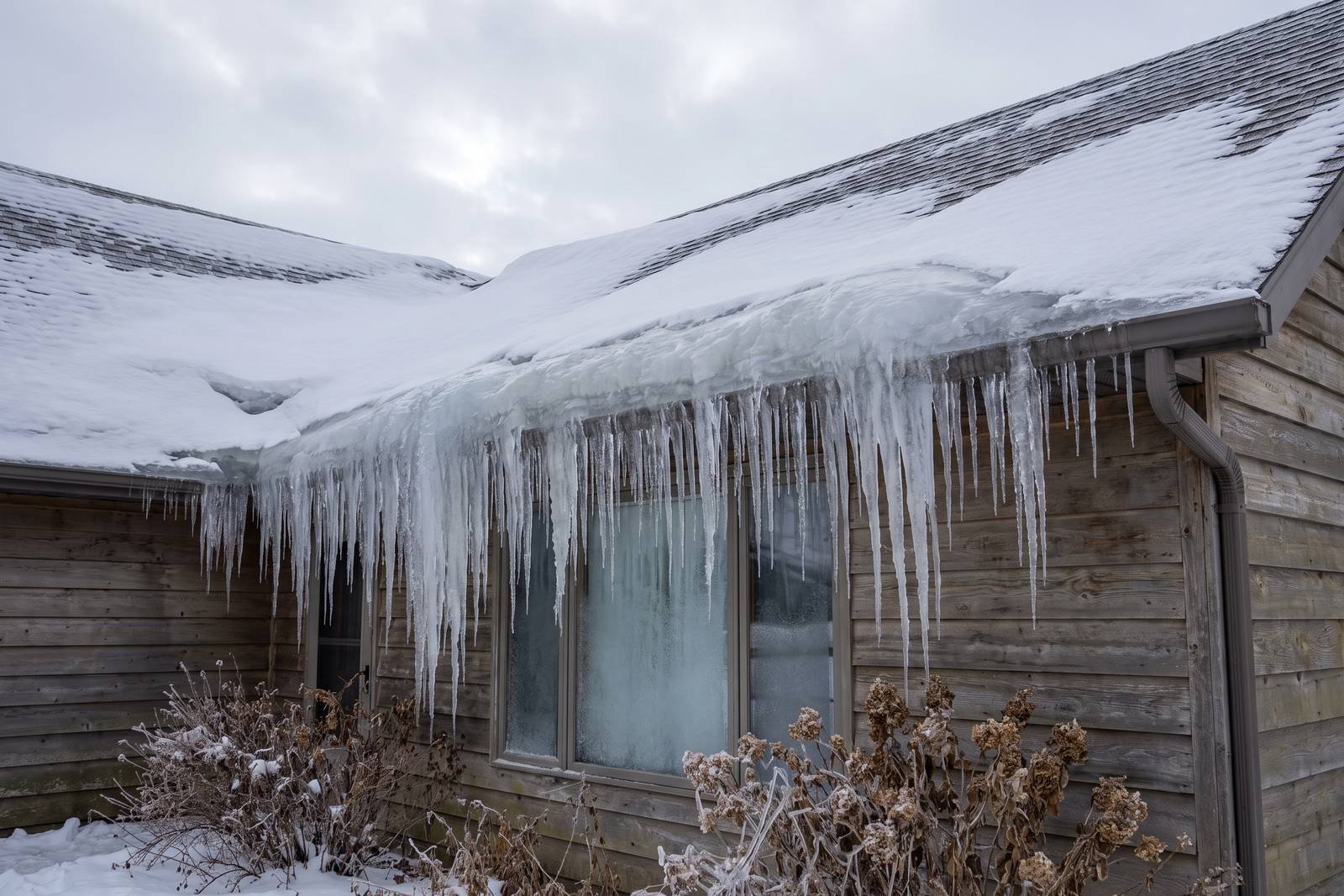
- Large ice dams at the eaves
- Interior doors on an upper floor rubbing their frames
Removing snow without wrecking the roof
- Use a roof rake from the ground. Clear the lower three or four feet, which also prevents ice dams. This is the whole job for most homes.
- Leave two inches on. Scraping to bare shingle takes granules with it.
- Work in horizontal strips from the edge upward, pulling snow straight down.
- Never get on a snow-covered roof. You cannot see what you are standing on and you will not hear the structure until it goes.
- Do not use a shovel or an axe on the roof surface. Cold shingles are brittle.
- Watch for power lines before extending an aluminum rake.
Metal roofs and snow
Metal sheds snow rather than holding it, which is a genuine structural advantage here and one of the better arguments for steel in this climate. The trade is that it comes off in slabs, so snow guards above doorways, walkways, the driveway and the gas meter are part of the job rather than an upgrade. See metal roof vs shingles.
If you are worried about a specific building
Commercial low-slope roofs, older farm buildings and additions built onto a house are the three we get called about most. A structural engineer is the right call when there is a visible sag. For everything else, an inspection before winter costs nothing and tells you whether drifting is building where it should not.
Want someone to actually look at it?
Free inspection anywhere in Ward County. Photo report the same day, and we will tell you if the roof is fine. Call (380) 247-5157 or request online.
Questions we get asked
How much snow can a roof hold?
Ward County roofs are engineered to a 35 pounds per square foot ground snow load. Depth alone does not tell you the load, because density varies: roughly 85 inches of light powder, 23 inches of packed snow, or 14 inches of wet snow all reach about 35 psf.
What are the warning signs a roof is overloaded with snow?
Cracking or popping noises from the structure, a new sag in the ceiling or roof line, doors and windows that suddenly stick, and fresh drywall cracks above door frames. Any of these means leave the building and call a professional immediately.
How do I safely remove snow from my roof?
Use a roof rake from the ground to clear the lower three or four feet, working in horizontal strips and leaving about two inches of snow so you do not scrape granules off the shingles. Never climb onto a snow-covered roof and never use a shovel or axe on the roof surface.
Why does one part of my roof have far more snow than the rest?
Wind drifting. Snow concentrates against parapets and taller walls, in valleys, on the lee side of a ridge, and below an upper roof that sheds onto a lower one. Drift loads can be two to three times the roof average, which is why failures start in one spot.
Related services
If you need this done
Free Roof Inspection
A roof inspection should end with photos and a number, not a sales pitch. We walk the roof, check the attic fr...
See details →Commercial Roofing
Commercial roofing in Minot, ND means low-slope membranes carrying a 35 psf snow load and drains that have to ...
See details →Metal Roofing
Metal is the roof that makes the most sense in this climate and the least sense on a spreadsheet, which is why...
See details →Keep reading
More straight answers
How Long Does a Roof Last in North Dakota?
Manufacturers publish lifespans measured in a lab. Here is what each roofing material actually delivers on a house that sees 38 inches of snow and -40 degree cold snaps.
Read →CostsHow Much Does a New Roof Cost in North Dakota?
What a roof replacement actually costs in Minot and across North Dakota in 2026, and which line items are real versus which are padding.
Read →WinterIce Dam Removal and Prevention in North Dakota
An ice dam is an attic problem wearing a roof costume. Here is how to get the water stopped today and how to stop it happening again.
Read →MaterialsMetal Roof vs Shingles in a North Dakota Winter
The comparison most articles get wrong, because they are written for climates that never see 38 inches of snow or a -40 cold snap.
Read →MaterialsAre Class 4 Impact Resistant Shingles Worth It in Hail Country?
A Class 4 shingle costs about 15 to 25 percent more. In a hail state the insurance discount often covers it. Here is how to check whether it does for you.
Read →StormRoof Inspection After a Hail Storm: What to Do First
Most denied hail claims are denied on documentation, not on damage. Here is the order to do things in.
Read →StormHow to File a Hail Damage Roof Insurance Claim
The claim process, the two policy types that decide what you actually receive, and what to do when the adjuster's scope comes back short.
Read →Roof Life9 Signs You Need a New Roof, Not Another Repair
Some of these you can see from the driveway. The two that matter most are inside your attic and in your gutters.
Read →ProcessHow Long Does It Take to Replace a Roof?
Most homes are a one or two day job. Here is what happens on each of those days, and the five things that add time.
Read →RepairHow to Find a Roof Leak (Before It Costs You a Ceiling)
Water travels along rafters before it drops. The wet spot on your ceiling is almost never directly below the entry point.
Read →ProcessWhen Is the Best Time to Replace a Roof in North Dakota?
Late spring and early fall give you the best install. Here is the month-by-month reality in a climate that hits both 95 F and -40 F.
Read →HiringHow to Choose a Roofing Contractor
The questions that filter out bad contractors are all things you can verify. None of them are about who seems nicest at the door.
Read →StormActual Cash Value vs Replacement Cost on a Roof Claim
Two policies, same storm, same roof: one pays $18,000 and the other pays $7,000. The difference is one line on your declarations page.
Read →Get a free roof inspection this week
Photo report the same day. No obligation, and no pressure if the roof is fine.