Repair · 7 min read · Updated 2026-08-23
How to Find a Roof Leak (Before It Costs You a Ceiling)
Water travels along rafters before it drops. The wet spot on your ceiling is almost never directly below the entry point.
First, tonight: limit the damage
- Move anything valuable out from under it.
- Put a bucket down. Lay a towel in the bucket to stop the drip noise driving you mad.
- If the ceiling is bulging, pierce it in the center with a screwdriver, into the bucket. That sounds wrong and it is right: draining it at one controlled point beats letting the water spread until the whole sheet of drywall comes down.
- Photograph everything before you clean up, for your insurer.
Why the stain is not under the hole
Water enters the roof, hits the sheathing, and runs downhill along the underside of the deck or along a rafter until it finds something to drip off. That can be ten or fifteen feet from where it got in. Chasing the stain is how you end up with a patched roof that still leaks.
Finding it from the attic, which is where you should start
Go up with a flashlight on a bright day, and turn the attic light off.
- Look for daylight through the deck. Obvious, and it does happen.
- Look for water staining on the underside of the sheathing, then follow the stain uphill. Water runs down; the entry point is always above the highest wet mark.
- Check every penetration from below: vent pipes, bath fans, chimney, anything that comes through the deck.
- Feel the insulation for damp patches.
- Look for rusted nail shanks, which means condensation rather than a leak.
Mark the highest wet point with a marker or a piece of tape. That is roughly what is above it on the roof.
The garden hose test
Two people, on a dry day, with the roof dry to start.
- One person in the attic with a flashlight, watching the suspect area.
- One person on a ladder with a hose, starting low on the roof, at the eave directly below the suspect area.
- Run water on one small area for several minutes. Not a spray across the whole roof.
- No leak? Move up two or three feet and repeat.
- Work upward until the person inside says water is coming in. That spot, or just above it, is your entry point.
The discipline is isolating one small area at a time. Hosing the whole roof tells you it leaks, which you already knew.
The five places leaks actually come from
1. Pipe boots, by a mile the most common
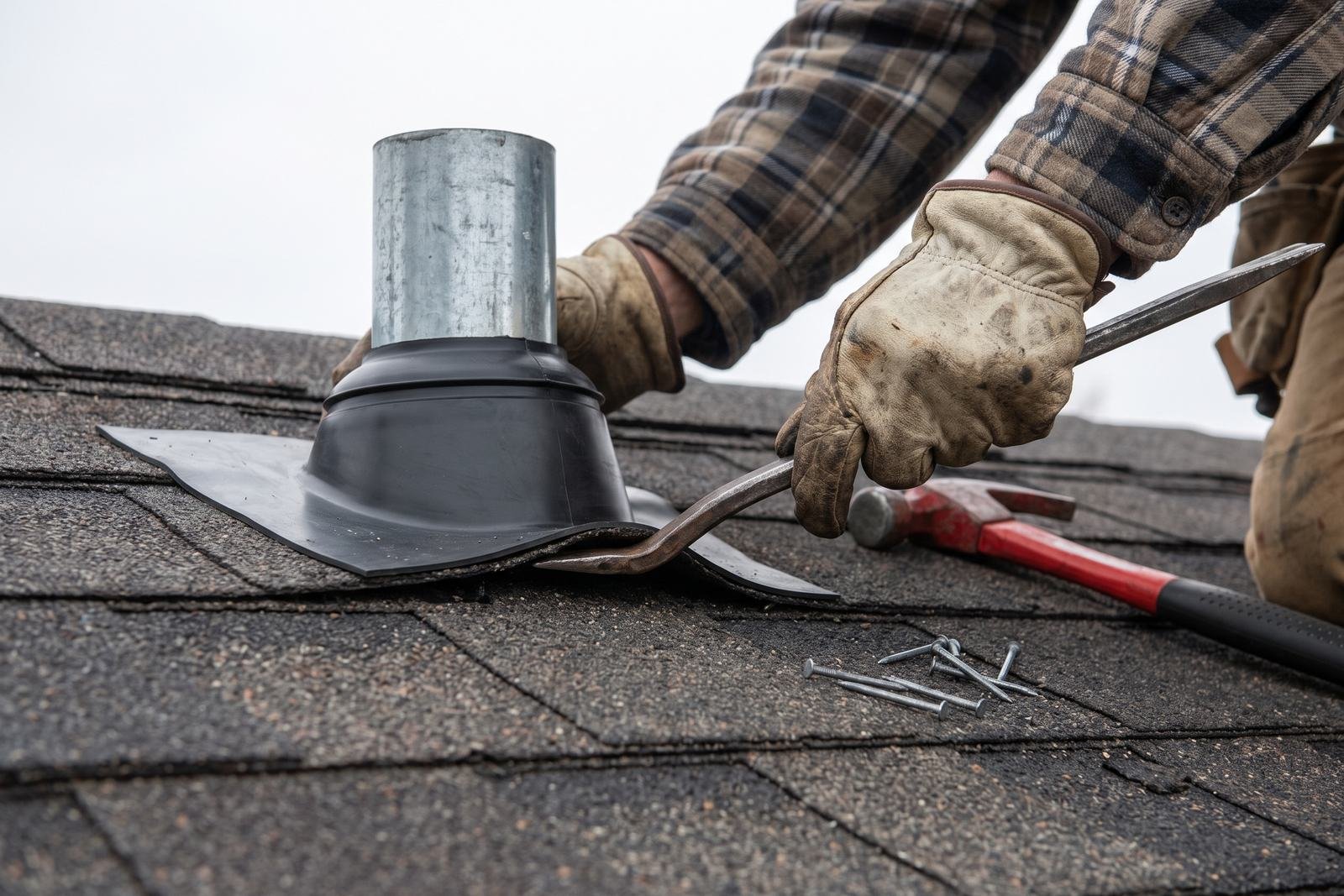
The rubber collar around a plumbing vent pipe dries out, cracks and splits, usually between years ten and twenty. It is also the cheapest thing on this list to fix.
2. Step flashing where a wall meets the roof
Individual metal pieces woven into each shingle course. When someone caulks over the joint instead of replacing the flashing, it fails again within a year or two.
3. Valleys
Two roof planes dumping into one channel means a lot of water at high speed. Debris packs in, the water backs up sideways under the shingles.
4. Chimney and skylight flashing
The counter-flashing should be let into the mortar joint. Caulk alone is a two-year fix at best.
5. Ice dams at the eave
If it only leaks in winter, during a thaw, this is almost certainly it. That is an attic insulation and ventilation problem, not a shingle problem. See ice dam removal and prevention.
Things that look like a roof leak and are not
- Condensation. Frost on the nails in winter, damp across a wide area rather than one spot, worse in cold weather. That is a ventilation problem.
- A plumbing leak in a wall or an upstairs bathroom.
- An HVAC condensate line backed up in the attic, which drips all summer and never in winter. The tell is that it leaks when it has not rained.
Test: does it only ever happen during or after rain? If no, look at plumbing and HVAC first.
When to stop and call someone
If the roof is steep, wet, icy, or you would be on a ladder above one story, stop. A repair costs a few hundred dollars. A fall costs considerably more. We inspect free anywhere in Ward County and send you the photos either way.
Want someone to actually look at it?
Free inspection anywhere in Ward County. Photo report the same day, and we will tell you if the roof is fine. Call (380) 247-5157 or request online.
Questions we get asked
Why is the water stain not directly under the roof leak?
Water entering the roof runs along the underside of the sheathing or down a rafter until it finds a low point to drip from. That can be ten or fifteen feet from the entry point, which is why patching directly above a ceiling stain often fails.
How do you find a roof leak with a hose?
Two people on a dry day. One watches from inside the attic while the other runs water on one small area at a time, starting low at the eave and moving progressively uphill. The entry point is at or just above wherever water first appears inside.
What is the most common cause of a roof leak?
Failed pipe boots, the rubber collars around plumbing vent pipes. They dry out and crack between roughly years ten and twenty, and they are also among the cheapest repairs.
My roof only leaks in winter. Why?
That is almost always an ice dam rather than a roof defect. Attic heat melts snow, the meltwater refreezes at the cold overhang and dams, and water backs up under the shingles. The permanent fix is attic air sealing and ventilation.
Related services
If you need this done
Roof Repair
A stain on the ceiling is almost never directly under the hole. Water travels along rafters and sheathing befo...
See details →Free Roof Inspection
A roof inspection should end with photos and a number, not a sales pitch. We walk the roof, check the attic fr...
See details →Roof Replacement
If your roof is past twenty years or the last hailstorm finished it off, a full replacement costs less over ti...
See details →Keep reading
More straight answers
How Long Does a Roof Last in North Dakota?
Manufacturers publish lifespans measured in a lab. Here is what each roofing material actually delivers on a house that sees 38 inches of snow and -40 degree cold snaps.
Read →CostsHow Much Does a New Roof Cost in North Dakota?
What a roof replacement actually costs in Minot and across North Dakota in 2026, and which line items are real versus which are padding.
Read →WinterIce Dam Removal and Prevention in North Dakota
An ice dam is an attic problem wearing a roof costume. Here is how to get the water stopped today and how to stop it happening again.
Read →MaterialsMetal Roof vs Shingles in a North Dakota Winter
The comparison most articles get wrong, because they are written for climates that never see 38 inches of snow or a -40 cold snap.
Read →MaterialsAre Class 4 Impact Resistant Shingles Worth It in Hail Country?
A Class 4 shingle costs about 15 to 25 percent more. In a hail state the insurance discount often covers it. Here is how to check whether it does for you.
Read →StormRoof Inspection After a Hail Storm: What to Do First
Most denied hail claims are denied on documentation, not on damage. Here is the order to do things in.
Read →StormHow to File a Hail Damage Roof Insurance Claim
The claim process, the two policy types that decide what you actually receive, and what to do when the adjuster's scope comes back short.
Read →Roof Life9 Signs You Need a New Roof, Not Another Repair
Some of these you can see from the driveway. The two that matter most are inside your attic and in your gutters.
Read →ProcessHow Long Does It Take to Replace a Roof?
Most homes are a one or two day job. Here is what happens on each of those days, and the five things that add time.
Read →ProcessWhen Is the Best Time to Replace a Roof in North Dakota?
Late spring and early fall give you the best install. Here is the month-by-month reality in a climate that hits both 95 F and -40 F.
Read →HiringHow to Choose a Roofing Contractor
The questions that filter out bad contractors are all things you can verify. None of them are about who seems nicest at the door.
Read →WinterRoof Snow Load: How Much Snow Can a Roof Hold?
Ward County builds to 35 psf. Here is how to work out what is actually sitting up there, and the signs that say get out of the house.
Read →StormActual Cash Value vs Replacement Cost on a Roof Claim
Two policies, same storm, same roof: one pays $18,000 and the other pays $7,000. The difference is one line on your declarations page.
Read →Get a free roof inspection this week
Photo report the same day. No obligation, and no pressure if the roof is fine.