Storm · 8 min read · Updated 2026-08-02
How to File a Hail Damage Roof Insurance Claim
The claim process, the two policy types that decide what you actually receive, and what to do when the adjuster's scope comes back short.
Before you call: read two lines on your declarations page
Find your declarations page and locate these two items. They determine everything.
1. RCV or ACV
Replacement cost value pays what it costs to replace the roof today. It is normally paid in two parts: an initial actual-cash-value check, then the withheld depreciation released once the work is finished and invoiced.
Actual cash value pays replacement cost minus depreciation for the roof's age, and that is all you get. On a 15 year old roof this can be half. Some policies convert to ACV for roofs over a certain age even when the rest of the policy is RCV. Look for a "roof surfacing payment schedule" endorsement.
2. Your wind and hail deductible
North Dakota policies frequently carry a separate wind and hail deductible expressed as a percentage of the dwelling coverage, not a flat dollar amount. On a $350,000 dwelling, 2 percent is $7,000. Homeowners routinely discover this at claim time.
The claim process
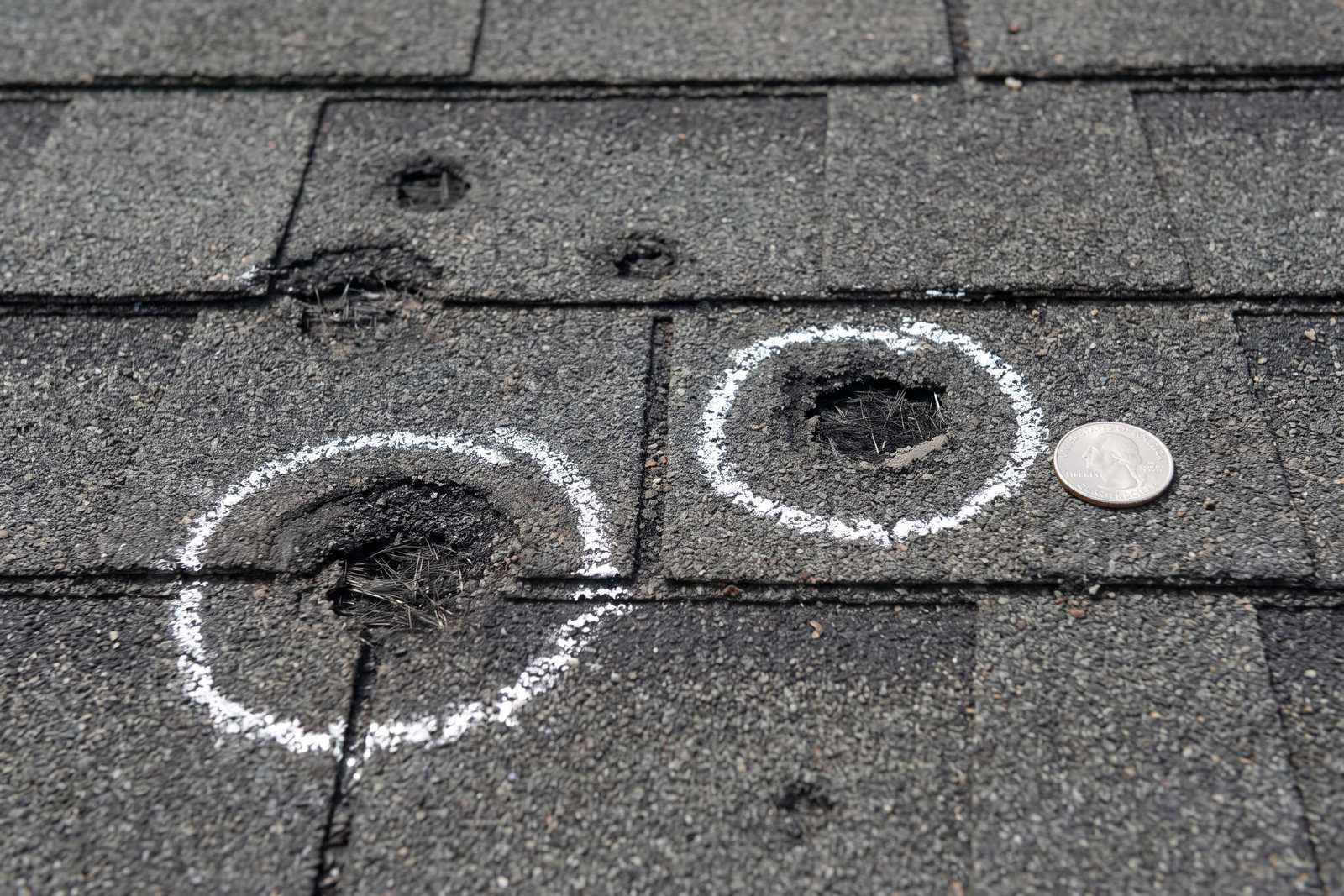
- Document first. Photos of ground hail with a scale, soft metal dents, date and time. Get a free contractor inspection with a photo report.
- Report the claim. Give the date of loss and describe the damage factually. You will receive a claim number and an adjuster assignment.
- Schedule the adjuster inspection and have your contractor there. This is the single highest-leverage thing you can do. Two people on the roof looking at the same slopes at the same time resolves disputes before they become disputes.
- Receive the scope and estimate. This is a line-item document listing every task and quantity the insurer will pay for.
- Compare the scope to your contractor's. Missing items are normal and are addressed by supplement, not by argument.
- Work is done, final invoice submitted, depreciation released if you are on RCV.
Items commonly missing from an adjuster scope
These are legitimate supplement requests, not padding:
- Ice and water shield where current code requires it but the old roof lacked it
- Drip edge, which is code-required and frequently omitted
- Ridge vent replacement rather than reuse
- Starter course at eaves and rakes
- Steep or high charges where the pitch warrants them
- Detach and reset of satellite dishes, solar, gutters
- Deck replacement discovered after tear-off
- Permit fees
Your contractor submits these with photos and code citations. Most get approved. This is a normal part of the process, and a contractor who does not know how to supplement will either eat the cost or cut the scope of your roof.
If the scope is too low or the claim is denied
- Get it in writing. The stated reason matters.
- Request a re-inspection with your contractor present.
- Submit additional evidence: strike counts in test squares, third-party hail reports, photos of soft metal damage.
- Invoke the appraisal clause. Nearly every policy has one. Each side appoints an appraiser, the two select an umpire, and the resulting decision is binding on the amount of loss. It is much faster and cheaper than litigation.
- File with the North Dakota Insurance Department if you believe the claim is being handled in bad faith.
Things that will hurt you
- Signing a contingency agreement at the door. Read what you sign. Some assign your claim rights to the contractor.
- Accepting a deductible waiver. It is insurance fraud in North Dakota and it exposes you, not just the contractor.
- Starting work before the adjuster inspects. Emergency tarping is fine and expected. A full tear-off before inspection destroys your evidence.
- Waiting. Every month makes causation harder to prove.
- Taking the check and not doing the work on an RCV policy. You forfeit the withheld depreciation, and an unrepaired roof can affect coverage at renewal.
Want someone to actually look at it?
Free inspection anywhere in Ward County. Photo report the same day, and we will tell you if the roof is fine. Call (380) 247-5157 or request online.
Questions we get asked
What is the difference between RCV and ACV on a roof claim?
Replacement cost value pays the full cost to replace the roof, usually in two payments with the depreciation released after the work is done. Actual cash value pays replacement cost minus depreciation for the roof's age, and that is the whole payout.
Should my roofer be present when the insurance adjuster inspects?
Yes. It is the highest-leverage step in the whole process. Having both on the roof at the same time resolves disagreements about what is storm damage before they harden into a low scope.
What is a supplement on an insurance claim?
A request to add items the initial adjuster scope missed, such as code-required ice and water shield, drip edge, starter course or decking found after tear-off. Submitted with photos and code citations, most are approved. It is routine, not a dispute.
Can a contractor pay my insurance deductible?
No. Waiving or absorbing a deductible is insurance fraud in North Dakota and exposes the homeowner as well as the contractor. Any contractor who offers it is telling you how they handle the rest of the job.
Related services
If you need this done
Storm & Hail Damage
North Dakota sits at the top of the hail belt and Ward County takes storms every season from May through Septe...
See details →Free Roof Inspection
A roof inspection should end with photos and a number, not a sales pitch. We walk the roof, check the attic fr...
See details →Roof Replacement
If your roof is past twenty years or the last hailstorm finished it off, a full replacement costs less over ti...
See details →Keep reading
More straight answers
How Long Does a Roof Last in North Dakota?
Manufacturers publish lifespans measured in a lab. Here is what each roofing material actually delivers on a house that sees 38 inches of snow and -40 degree cold snaps.
Read →CostsHow Much Does a New Roof Cost in North Dakota?
What a roof replacement actually costs in Minot and across North Dakota in 2026, and which line items are real versus which are padding.
Read →WinterIce Dam Removal and Prevention in North Dakota
An ice dam is an attic problem wearing a roof costume. Here is how to get the water stopped today and how to stop it happening again.
Read →MaterialsMetal Roof vs Shingles in a North Dakota Winter
The comparison most articles get wrong, because they are written for climates that never see 38 inches of snow or a -40 cold snap.
Read →MaterialsAre Class 4 Impact Resistant Shingles Worth It in Hail Country?
A Class 4 shingle costs about 15 to 25 percent more. In a hail state the insurance discount often covers it. Here is how to check whether it does for you.
Read →StormRoof Inspection After a Hail Storm: What to Do First
Most denied hail claims are denied on documentation, not on damage. Here is the order to do things in.
Read →Roof Life9 Signs You Need a New Roof, Not Another Repair
Some of these you can see from the driveway. The two that matter most are inside your attic and in your gutters.
Read →ProcessHow Long Does It Take to Replace a Roof?
Most homes are a one or two day job. Here is what happens on each of those days, and the five things that add time.
Read →RepairHow to Find a Roof Leak (Before It Costs You a Ceiling)
Water travels along rafters before it drops. The wet spot on your ceiling is almost never directly below the entry point.
Read →ProcessWhen Is the Best Time to Replace a Roof in North Dakota?
Late spring and early fall give you the best install. Here is the month-by-month reality in a climate that hits both 95 F and -40 F.
Read →HiringHow to Choose a Roofing Contractor
The questions that filter out bad contractors are all things you can verify. None of them are about who seems nicest at the door.
Read →WinterRoof Snow Load: How Much Snow Can a Roof Hold?
Ward County builds to 35 psf. Here is how to work out what is actually sitting up there, and the signs that say get out of the house.
Read →StormActual Cash Value vs Replacement Cost on a Roof Claim
Two policies, same storm, same roof: one pays $18,000 and the other pays $7,000. The difference is one line on your declarations page.
Read →Get a free roof inspection this week
Photo report the same day. No obligation, and no pressure if the roof is fine.